

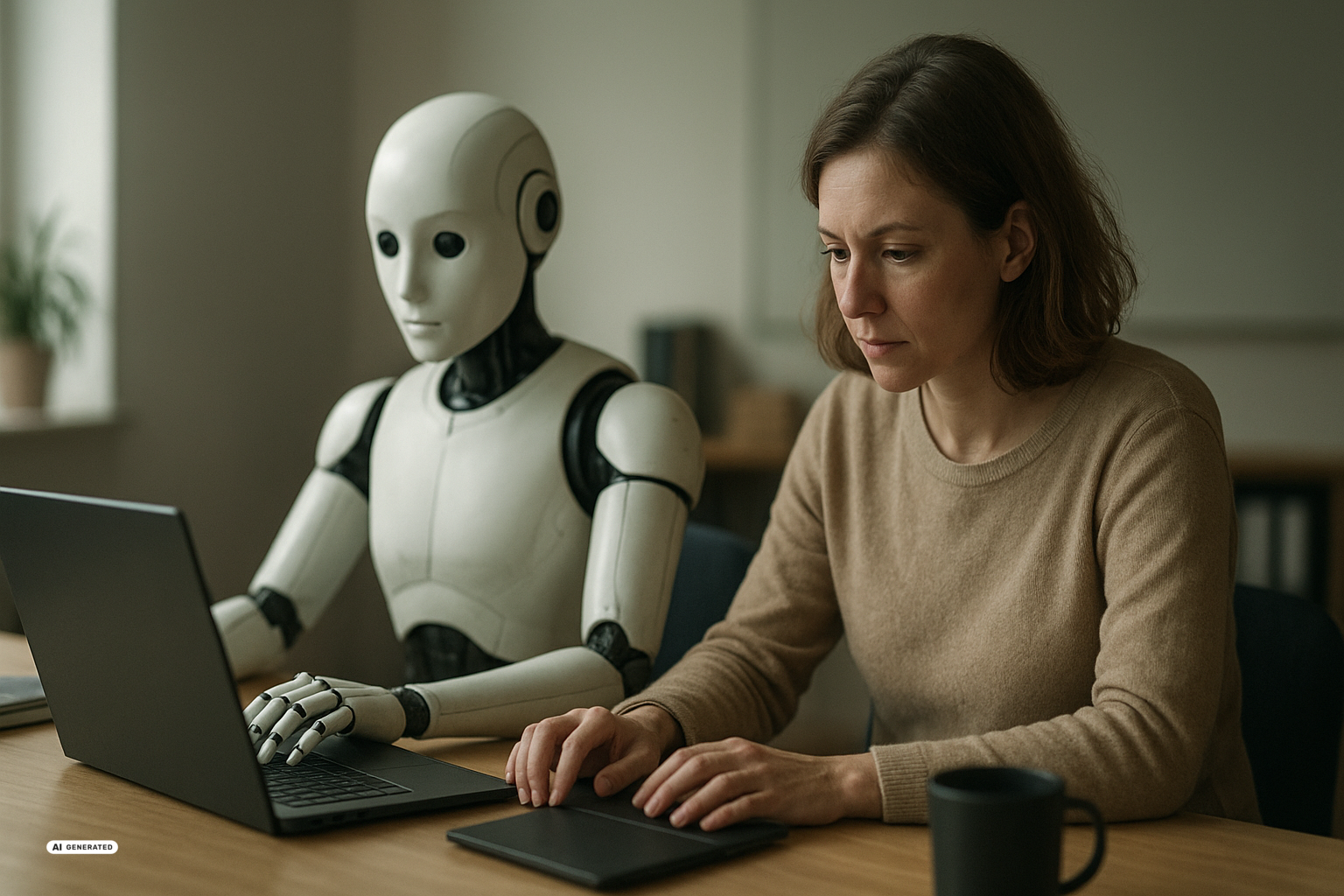
Claude can now use information from conversations in its Cowork working mode, reducing the need to repeat earlier instructions. This closer link between memory and execution shows how Artificial Intelligence (AI) is moving from an occasional writing tool toward a digital coworker. What matters to you is not whether the AI feels human, but which tasks it can handle reliably and where oversight remains essential.
What AI does better as a coworker
According to the report on Claude’s shared memory, Anthropic is merging the memory systems used by chat and Claude Cowork. Information Claude picks up in a conversation should therefore remain available when Cowork carries out a task. Previously, users often had to explain a project again when moving from discussing an idea to acting on it.
Conference planning offers a concrete example. If you have already discussed the headcount, city, and speakers with Claude, Cowork can use those details later to prepare an agenda or draft an update for your manager. The useful part is not a spectacular new skill but the removal of repetitive briefing whenever you change modes.
According to Anthropic, Claude now adds topics to memory while a conversation is still underway rather than creating a summary only after it ends. You can read, edit, or delete the retained information. That makes the system more transparent than one that quietly remembers details without showing you what it believes it knows.
The provider says the feature is enabled by default on Free, Pro, and Max plans across the web, desktop, and mobile apps. Users on iOS and Android need the latest version of the app; the supplied source does not state prices. It also provides no details about performance across different languages or special terms for people and organizations in Switzerland.
What can be accelerated reliably
The clearest benefits appear in frequent processes built around similar inputs. A case study on automated document processing describes DFKP GmbH, which receives about 1,000 documents per day, often bundled into unsorted PDF files. Sorting them previously occupied between 2.5 and three full-time employees.
The platform separates bundled files, classifies each document, and extracts the relevant fields. It then sends the data to a customer relationship management system (CRM), the central software used to manage customer and case information. According to the report, the workload fell to 0.5 full-time employees, while documents returned because of errors dropped from about 25 to two or three per week.
This is not a fully automated replacement workforce. Every document receives a confidence score, meaning the system’s estimate of how certain its classification is. A case proceeds without human review only if it exceeds a threshold set for that document class; for the most important classes, 90 to 95 percent pass automatically. DFKP explicitly considers 100 percent automation the wrong target.
The implementation effort also challenges the idea of an instant, ready-made solution. Initial setup required 80 to 90 person-days, almost half of them spent on corrections and refinements. The company had previously tested optical character recognition (OCR), which extracts text from scans, along with in-house workflows. Liability and availability concerns led it to choose an external operator offering contractual availability commitments.
Another area is the creation of small internal tools. OpenAI says travel company loveholidays uses Codex across its business to help teams turn ideas into products faster. However, the brief provider summary includes no measurements or details about cost, errors, or human review, so the claimed benefit has not been independently verified.
Pros and Cons of AI as a coworker
Pros:
- Less repetition – Shared memory can keep you from reentering project details when you move between discussion and execution.
- Faster routine work – Sorting, classifying, and transferring standardized documents can largely be automated when the rules are clear.
- More capacity – In the DFKP example, document volume increased substantially without additional staff being added.
- Lower entry barriers – According to the provider, tools such as Codex can help teams outside conventional development roles implement ideas.
Cons:
- Errors remain – Even a successful document workflow still produces cases that are misclassified or require human clarification.
- Memory creates data risks – The more context an AI retains, the more carefully you must check which personal or business details are stored.
- Deployment requires work – Integrations, thresholds, corrections, and lines of responsibility do not disappear when an organization buys an AI tool.
- Provider evidence is limited – Some reported advantages come directly from vendors and are not independently verified in the supplied material.
What this means for your work
If you are getting started, choose a recurring task with limited consequences. This could be a first draft of an internal update or the sorting of nonsensitive files into familiar categories. Compare several results with your previous work, and verify names, numbers, categories, and missing context before anything is passed on.
Do not treat an AI memory as a convenient dumping ground for every available detail. Anthropic says Claude does not store personal or sensitive information such as health data, race, ethnicity, religion, political views, or gender identity by default. Users can opt into retaining sensitive topics and should receive a notification when such information is saved; some data, including government-issued identification numbers, is not supposed to be stored at all.
For advanced users, the larger benefit lies in building a tiered process. Define which cases may proceed automatically, which samples you will inspect, and what confidence level triggers human intervention. In document processing, the appropriate limits may differ between contracts and delivery notes because an identical mistake can have very different consequences.
You should also document who is responsible for approvals, corrections, and system outages. For an organization in Switzerland, language support, stored business data, access rights, and the location or contractual handling of data are practical review points. The supplied sources offer no Switzerland-specific privacy rules or availability guarantees, so they do not support a blanket approval for local use.
What remains unresolved about responsibility and junior staff
The shift in roles is particularly visible in software development. In so-called vibe coding, a person describes the intended function in natural language while the AI generates the source code. A Swiss software industry overview stresses that moving from a quick prototype to software used in production still requires quality assurance, security, governance, maintenance, and operations.
Human work therefore moves rather than disappears, shifting toward direction, evaluation, and accountability. Expertise is still needed to distinguish an output that merely looks plausible from one that fits the existing environment and business purpose. The article also references a professor at the Eastern Switzerland University of Applied Sciences discussing the approach’s limits, the computing knowledge still required, and how companies can identify measurable value.
This also affects junior employees. Agentic coding refers to systems that do more than suggest isolated lines of code and instead carry out multistep development tasks with a degree of autonomy. An article about potentially replacing junior engineers reportedly defines four falsifiable conditions and tests them against several primary sources. The supplied summary provides neither those conditions nor the conclusion, so it does not establish that junior staff can actually be replaced.
Junior employees do more than complete simple assignments. They learn systems, test assumptions, acquire domain knowledge, and form the future pool of experienced specialists. If companies automate all entry-level work, they may reduce processing time in the short term while weakening the path through which people develop judgment and responsibility. Better code generation does not automatically resolve that organizational risk.
AI is already a useful coworker for clearly bounded, repetitive, and verifiable tasks. The examples show measurable relief alongside deployment costs, remaining errors, and new questions about retained data. The central unresolved issue is how organizations can improve efficiency without hollowing out oversight, expertise, and the development of their next generation of employees.
Sources
- Claude Cowork finally remembers what you told the app in chat – TechCrunch, 2026-08-25
- How loveholidays is making everyone a builder with Codex – OpenAI, 2026-08-26
- Von 25 auf 3 Fehler pro Woche: So automatisiert ein Mittelständler seinen Dokumenteneingang – t3n, 2026-08-26
- Code nach Gefühl – wie Vibe Coding die Softwareentwicklung herausfordert – Netzwoche, 2026-08-26
- What Would Have to Be True for Agentic Coding to Replace Junior Engineers – MarkTechPost, 2026-08-26