

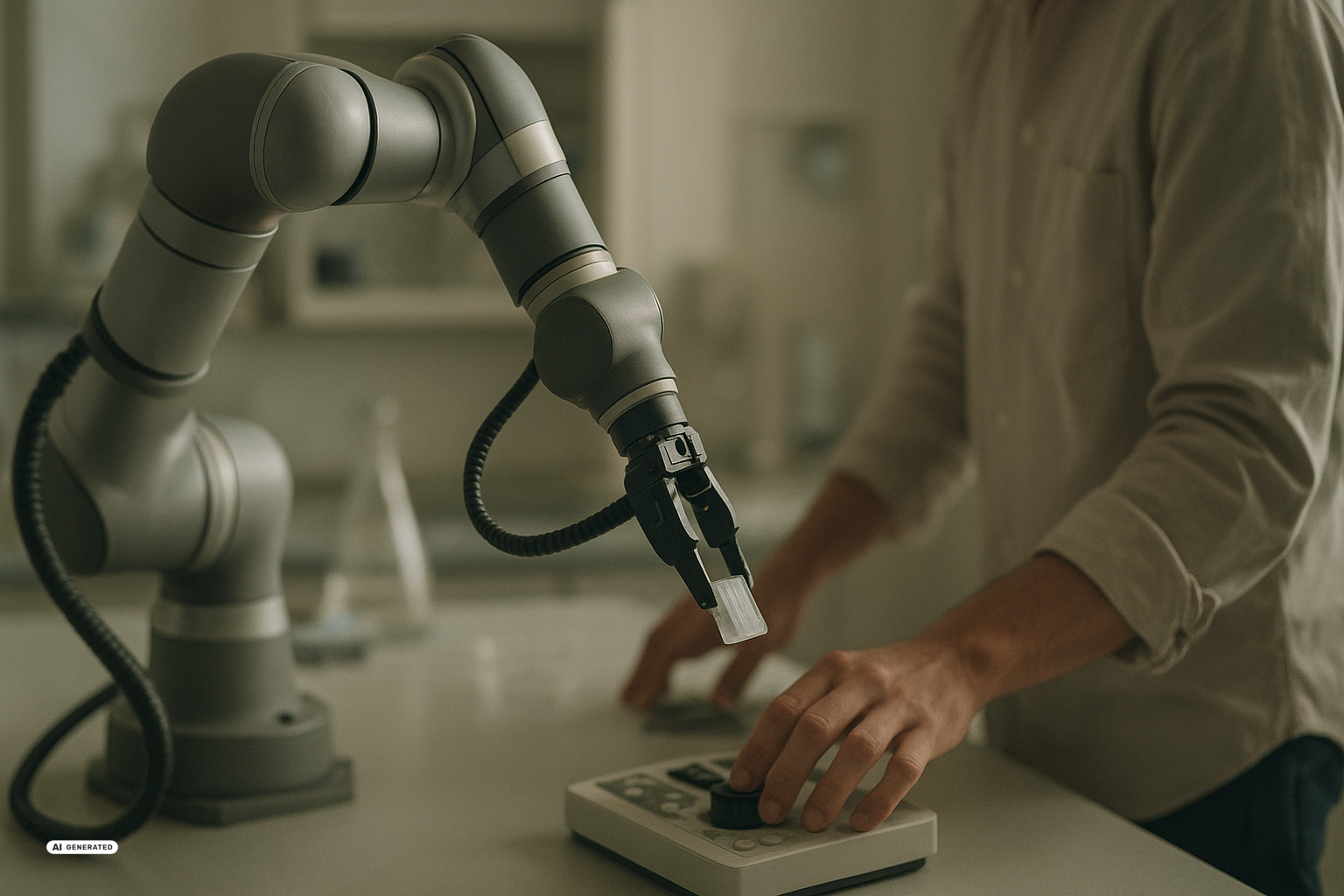
Anthropic’s Model Hardware Standard (MHS) is designed to give Artificial Intelligence (AI) agents a shared interface for microscopes, robot arms, and other physical devices. The research preview initially concerns selected laboratories and manufacturers, but it illustrates how AI could move from digital workflows into real equipment. This matters to you because such systems may eventually change research, maintenance, and physical work.
The standard behind device control
An AI agent is a software system that divides a goal into steps and performs suitable actions. With physical equipment, that process often runs into incompatible programming interfaces, data formats, and control software. A microscope does not understand the same commands as a robot arm, and even similar devices from different manufacturers cannot necessarily work together.
MHS is intended to reduce that fragmentation through standardized drivers. A driver is software that translates commands between a system and a device. According to the announcement of the MHS research preview, AI agents can use the specification to discover devices, identify their functions, and operate them through a common format.
The standard is meant to work independently of the AI model being used. According to Anthropic, safety limits are enforced in the driver rather than merely written into a prompt. A prompt is the input through which you assign a task to an AI model. That separation is sensible because a technical restriction is harder to remove accidentally through an ambiguous or faulty instruction.
MHS was developed with the HHMI Janelia Research Campus and, according to the report on Anthropic’s laboratory plans, is initially available only to selected research laboratories and manufacturers. Anthropic plans to release it as open source, meaning its source code would become publicly accessible. The supplied reports give neither a release date nor details of general availability.
The benefits in laboratories and workplaces
Anthropic says MHS can reduce the time needed to connect several instruments from weeks or months to hours or minutes. At Carnegie Mellon University, the process from raw equipment integration to a completed dose-response curve reportedly took eight hours. At QuEra, a laser relocking process is said to have improved from a 58 percent success rate to 99.3 percent across 700 trials. These figures come from the provider and have not been independently verified in the supplied sources.
The first practical example is a laboratory where several instruments run a series of experiments. An agent could collect measurements, prepare the next trial, and adjust settings within predefined limits. It could then generate a script that repeats the tested workflow without requiring a language model to remain active. A language model is an AI system that processes and generates language.
Google DeepMind is pursuing a related laboratory model with its expanded Co-Scientist research system. The multi-agent system, based on Gemini models, is intended to develop hypotheses, plan experiments, write code, control equipment, and evaluate results. In materials research, it created recipes for a semiautomated high-temperature furnace; after 25 experimental rounds with human refinement, researchers produced structures that reportedly resembled the target material. The atomic structure had not yet been definitively confirmed.
The value becomes tangible outside laboratories as well. Caterpillar’s AI assistant lets technicians standing beside a machine use voice commands to retrieve repair procedures, troubleshoot problems, and identify parts they may need. The company draws on proprietary machine data and reports about 1.6 million connected assets and more than 16 petabytes of structured data. The account also stresses that creating the technology is only part of the challenge; fitting it into daily operations remains difficult.
The path from model to machine
A common device interface does not automatically solve the problem of physical understanding. A model can produce a formally valid command while misjudging what a movement, temperature change, or power interruption will do in the real environment. Reporting on Anthropic’s tests says the system still has weaknesses in understanding physical relationships. Human supervision therefore remains necessary even when individual workflows can be optimized automatically.
Research teams are trying to build some of that understanding in simulations before transferring it to hardware. Microduck from Pollen Robotics and Hugging Face is a 25-centimeter bipedal robot whose movements are trained in MuJoCo, a physics simulation environment, and then exported to the real machine. According to the provider, the open-source robot costs $399 and includes 15 motors, a camera, LiDAR for measuring distance, and two motion-sensing units. Preorders are open, but the source provides no information about availability or pricing in Switzerland.
Code-as-World takes a related approach. It extracts editable MuJoCo scene code from real videos and uses the verified simulated worlds to train physical reasoning. A model could therefore examine movement in an executable simulation before a real robot attempts it. However, the brief source summary contains no results that would allow its reliability to be assessed.
Data centers demonstrate how mundane and consequential physical automation can be. According to a report on Meta’s data center robots, the company is testing systems that swap network cables, disconnect power from servers, or press power buttons. One employee estimated that a successful robot could replace up to 80 percent of some people’s workloads. Meta declined to comment on the reported tests and instead said it needed more skilled workers to build and operate its data centers.
Pros and Cons of physical AI agents
Pros:
- Faster integration – standardized drivers could substantially reduce the work required to connect different devices, according to Anthropic.
- Repeatable workflows – an agent can preserve an optimized process as a script, so every run does not have to remain under language-model control.
- Work in hazardous environments – Caterpillar has long used automated and remotely controlled mining equipment, where dangerous conditions and labor shortages make automation especially useful.
- More accessible experiments – open systems such as Microduck put the workflow from simulation training to a physical robot on a desk at a stated price.
Cons:
- Limited physical understanding – valid commands do not guarantee that an AI agent correctly anticipates their real-world effects.
- Unverified performance claims – several striking figures come from providers or participating research teams and are not independently confirmed in the supplied reports.
- Effects on workers – Meta’s tests expose a tension between reducing routine work and fears that robots could take over large portions of particular jobs.
- Demanding deployment – Caterpillar’s experience shows that data, machinery, and work processes must fit together; buying an AI system is not enough.
The next steps for you
For beginners
Your most useful first step is to distinguish a demonstration from an available product. MHS is a research preview for selected organizations, while Microduck can be preordered at a stated price and Caterpillar’s assistant is already used by customers, operators, and technicians. When reading announcements, check whether a system is merely planned, undergoing tests, or operating in daily work.
Machine maintenance offers a practical way to picture the progression. Today, an assistant can give a technician suitable repair instructions and identify likely replacement parts. The next stage would be an agent that also reads measuring instruments or moves a robot arm within defined limits. Safety checks, device integration, and human responsibility still sit between those stages.
For advanced users
If you assess these systems professionally, examine the limits enforced by the driver, the logging of physical actions, and the ability to stop a workflow at any point. It also matters whether generated findings are checked against actual execution records. Google DeepMind’s Co-Scientist uses verification modules intended to compare figures in generated text with logs from executed code, reducing fabricated results.
For Switzerland, the sources provide no details about general availability, supported languages, or specific data-protection arrangements. Microduck’s price is also given only in US dollars. Swiss laboratories, educational institutions, and businesses can evaluate the approaches in principle, but these reports do not establish local purchasing conditions or data-protection suitability.
AI agents are not leaving the screen in one dramatic leap, but through standardized drivers, narrowly defined tasks, simulations, and human-controlled trials. Examples from laboratories, data centers, mining, and maintenance show practical value without demonstrating reliable general autonomy. The unresolved risk is that a plausible-acting system may misunderstand the physical effects of its commands or displace more work than providers publicly anticipate.
Sources
- Anthropic Opens a Research Preview of the Model Hardware Standard (MHS) – Unknown, 2026-08-30
- Anthropic will KI-Agenten aus der digitalen Welt in Labore und Fabriken bringen – Unknown, 2026-08-29
- Hugging Face Unveils Microduck: A $399 Open-Source 25 cm Biped – Unknown, 2026-08-29
- Inside Meta’s push to put robots to work in data centers – Unknown, 2026-08-30
- Caterpillar is bringing to AI deployment what it learned from automating mining – Unknown, 2026-08-30
- Google Deepminds Co-Scientist wird vom Hypothesengenerator zum Forschungspartner – Unknown, 2026-08-28
- Meet Code-as-World: An Agentic Loop That Rewrites Real Videos Into Executable MuJoCo Physics Programs – Unknown, 2026-08-30