

Google is adding new Artificial Intelligence (AI) features to Gmail, Docs, and Keep while feeding more precise weather forecasts into its services. This affects you if you handle email and documents on the move, search long message threads for appointments, or plan travel around the weather. At the same time, Gemini 3.8 Flash promises stronger performance, although stronger performance does not necessarily mean lower costs.
What you can control by voice
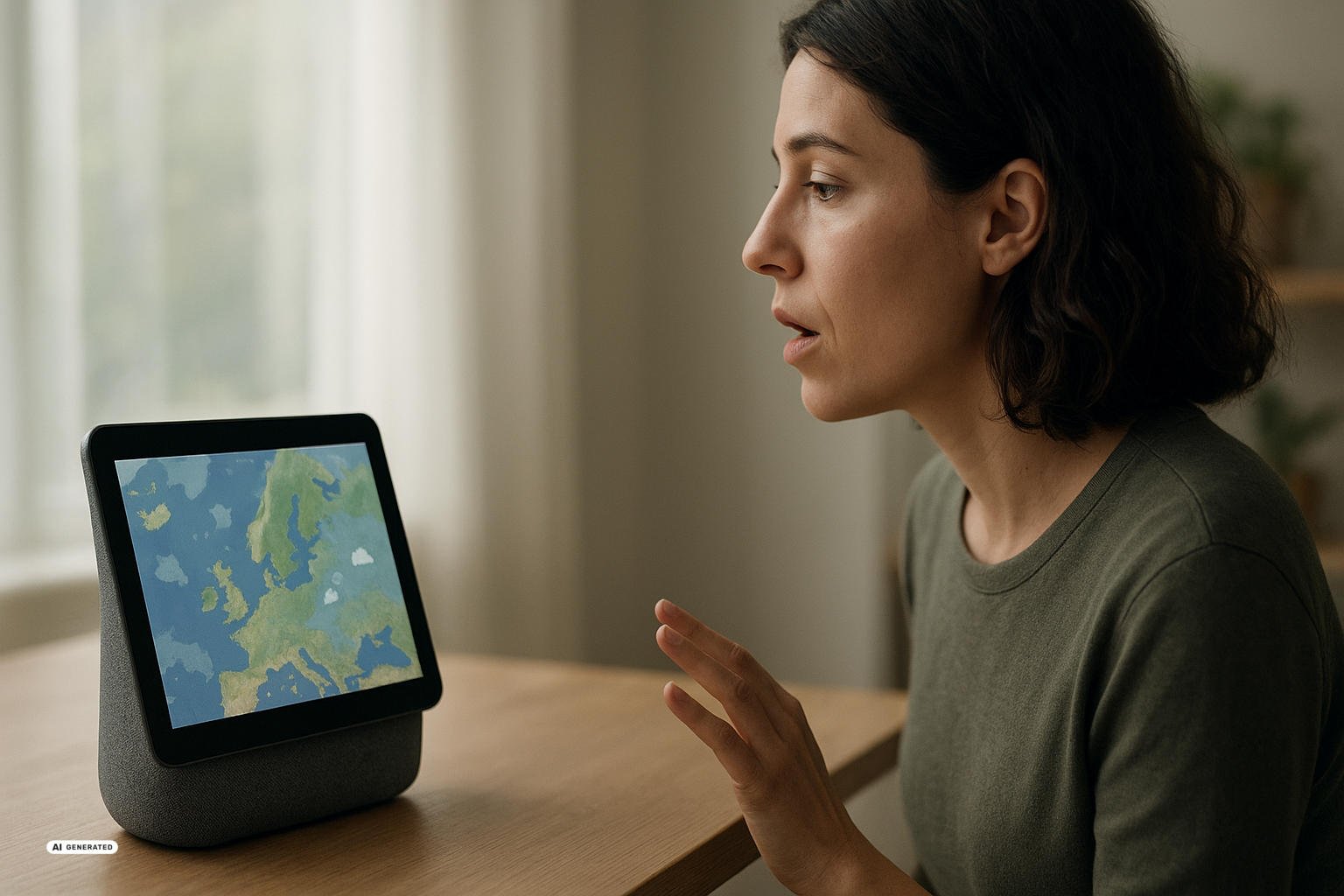
Google is introducing dedicated Live modes for Gmail, Docs, and Keep. Gmail Live, Docs Live, and Keep Live are designed for real-time conversation, similar to Gemini Live in Google’s chatbot. Instead of navigating menus and reading through text, you talk to the relevant application, ask follow-up questions, and interrupt an answer when you need to change direction.
Gmail Live searches your inbox for relevant information and summarizes what it finds aloud. One concrete example in the report on Google’s new voice modes is asking about your child’s next school event: the assistant is supposed to locate the information in incoming emails, read back a summary, and link its source messages in the on-screen transcript. That is useful when a detail is buried in a long conversation and you do not remember the exact sender or subject line.
Docs Live can organize spoken ideas into a structured document, summarize longer material, or turn your description into a business proposal. With your permission, it can draw information from Gmail, Drive, Chat, and the web. Keep Live lets you speak naturally and transcribes your words, meaning it automatically converts your speech into written text.
The more substantial change is not dictation itself but the conversational context. You might first request a summary, then ask for a specific date or unresolved item without restating the entire task. The supplied reports do not say when every feature will be available in Switzerland, which languages will receive full support, or whether a particular subscription will be required.
How WeatherNext 3 changes planning
WeatherNext 3 is Google’s new AI model for global weather forecasting. It processes current observations from geostationary satellites, which continuously monitor the same region of Earth, and produces a new forecast every hour. According to Google DeepMind, its results are being integrated into Google Search, Gemini, Maps, Google Maps Platform, and Google Cloud.
The model is supposed to provide global forecasts at five-kilometer resolution, making its output five times sharper than Google’s previous model. Resolution in this context describes the size of the geographic grid used for a forecast. A separate summary of WeatherNext 3 also lists hourly updates and a global five-kilometer grid.
For everyday use, the reported improvement in rain and snowfall prediction is particularly relevant. When planning a trip, you could inspect a route in Maps while checking a fresher estimate of expected precipitation. Google also mentions variables for agriculture and clean energy, which may help with scheduling weather-dependent work or assessing potential energy output.
Traditional weather models use supercomputers to solve physical equations that describe the atmosphere. AI weather models instead recognize patterns in large collections of historical and current data and can generate predictions more quickly. WeatherNext 3 adds live satellite observations to that approach, aiming to shorten the delay between observed conditions and the latest forecast.
TechCrunch reports that WeatherNext 3 led several prominent AI and traditional models on Operational WeatherBench, a comparison system for AI forecasts that measures variables including temperature, wind speed, and humidity. However, central claims about improved accuracy still come from Google. The results look promising, but they do not prove that every local rain forecast in Switzerland will be correct; weather is a chaotic system in which small differences can grow substantially.
What Gemini 3.8 Flash contributes
Gemini 3.8 Flash is a general Google model intended for tasks such as reasoning, using external tools, and software work. Reasoning means that the model uses several processing steps to handle a complex request. Google says the new version works harder on demanding tasks than Gemini 3.7 Flash, which arrived only a few weeks earlier, and can call tools repeatedly.
For regular users, that may result in more developed answers, more thorough document drafts, or better handling of tasks with several stages. However, much of the reported performance evidence focuses on software development. The Decoder cites a score of 73.7 percent for Gemini 3.8 Flash on DeepSWE v1.1, a standardized test for extended software engineering tasks, compared with 65.3 percent for its predecessor; those figures are based on Google’s claims.
Pricing is usage-based and measured in tokens, small units of text or data that the model processes and generates. Introductory pricing is $0.75 per million input tokens and $3.75 per million output tokens. Although those rates match Gemini 3.7 Flash, Google warns in the report about Gemini 3.8 Flash that the model may consume more tokens while trying to improve its results.
An early assessment by Artificial Analysis reportedly found around 30 percent more output tokens per task and costs roughly 40 percent above the previous model, despite unchanged per-token rates. This is an early outside estimate rather than a universal calculation for every use case. The Decoder and MarkTechPost state that introductory pricing runs through the end of December 2026 and is expected to increase in January 2027 to $1.50 and $7.50 per million tokens, respectively.
Google is also releasing Gemini 3.8 Flash Cyber for cybersecurity work. The two variants reportedly use the same underlying model intelligence but are separated by different safety restrictions. According to MarkTechPost, the Cyber version scored 47.2 percent pass@1 on CWE-Bench, a test involving common software weaknesses, and is restricted to vetted defensive teams through the Fairwind Program. For ordinary work, the practical point is that not every Gemini variant is openly available.
Pros and Cons of Google AI in daily life
Pros:
- Less searching – Gmail Live can retrieve specific details from long email conversations and visibly link the messages it used.
- Hands-free control – Voice interaction can help when you are traveling or in situations where typing is inconvenient.
- Fresher weather data – Hourly satellite input may improve short-term planning for travel, work, and leisure.
- Connected services – Weather forecasts and AI assistance appear in familiar products such as Search, Maps, Gmail, and Docs.
Cons:
- Broad data access – Personalized documents may require access to Gmail, Drive, Chat, and the web, bringing more information into one workflow.
- Errors remain possible – A more precise forecast or a stronger benchmark score guarantees neither the right rain prediction nor a flawless summary.
- Unclear consumer costs – The sources provide usage-based model pricing but no complete cost details for the Live modes in Gmail, Docs, and Keep.
- Rapid model turnover – Gemini 3.8 Flash followed 3.7 Flash by only a few weeks, making features, costs, and model choices harder to track.
What this means for you
If you are a beginner, the most sensible first step is a narrowly defined request. You could ask Gmail Live for a date from a known email conversation or have Docs Live summarize an existing document. Then check the linked email or original text rather than relying on the spoken summary as your only source.
If you are an advanced user, you can build on follow-up questions and combine multiple information sources after granting access. One professional example based on the described features is to summarize a long project document and then turn it into a structured business proposal. It makes sense to give access to Gmail, Drive, or Chat only when the specific task actually needs those sources.
For weather planning, WeatherNext 3 is best treated as a fresher decision aid rather than a certainty. Before a trip, you could compare your Maps route with the latest rain or snow guidance; for weather-dependent work, hourly updates may help you review a schedule. The sources provide no specific validation for Swiss valleys or mountain regions and no figures for local forecasting accuracy.
Several questions also remain open for people in Switzerland who want to use the voice features. The available reports do not specify the regional rollout, support for Swiss German, or how data is handled under Swiss privacy requirements. Because Docs Live may access several Google services with permission, its practical value depends heavily on how much information you make available to the system.
Google’s updates connect voice control, productive AI, and weather data more closely with services many people already use. The clearest benefits are less time spent searching and access to fresher information, while Gemini 3.8 Flash is intended to work through complex tasks more thoroughly. The unresolved issues are the reliability of individual answers and local forecasts, actual consumer costs, and the amount of data access required.
Sources
- Google now lets you chat with Gmail, Docs, and Keep – The Verge, 2026-09-03
- Google DeepMind’s WeatherNext 3 Trains on Weather Station Observations to Deliver 5 km Global Forecasts, Refreshed Every Hour – MarkTechPost, 2026-09-04
- Introducing WeatherNext 3, our most advanced and accurate global weather AI model – Google DeepMind, 2026-09-03
- Google’s latest AI weather model gives you no excuse to forget your umbrella – TechCrunch, 2026-09-03
- Google says its AI weather model is getting better – The Verge, 2026-09-03
- Google says its new Gemini 3.8 Flash model ‘works harder’ but might cost more – The Verge, 2026-09-02
- Google DeepMind Releases Gemini 3.8 Flash and Gemini 3.8 Flash Cyber: One Core Model, Two Access Envelopes – MarkTechPost, 2026-09-02
- Googles Gemini Flash 3.8 arbeitet härter als der gerade mal drei Wochen alte Vorgänger 3.7 Flash – The Decoder, 2026-09-02