

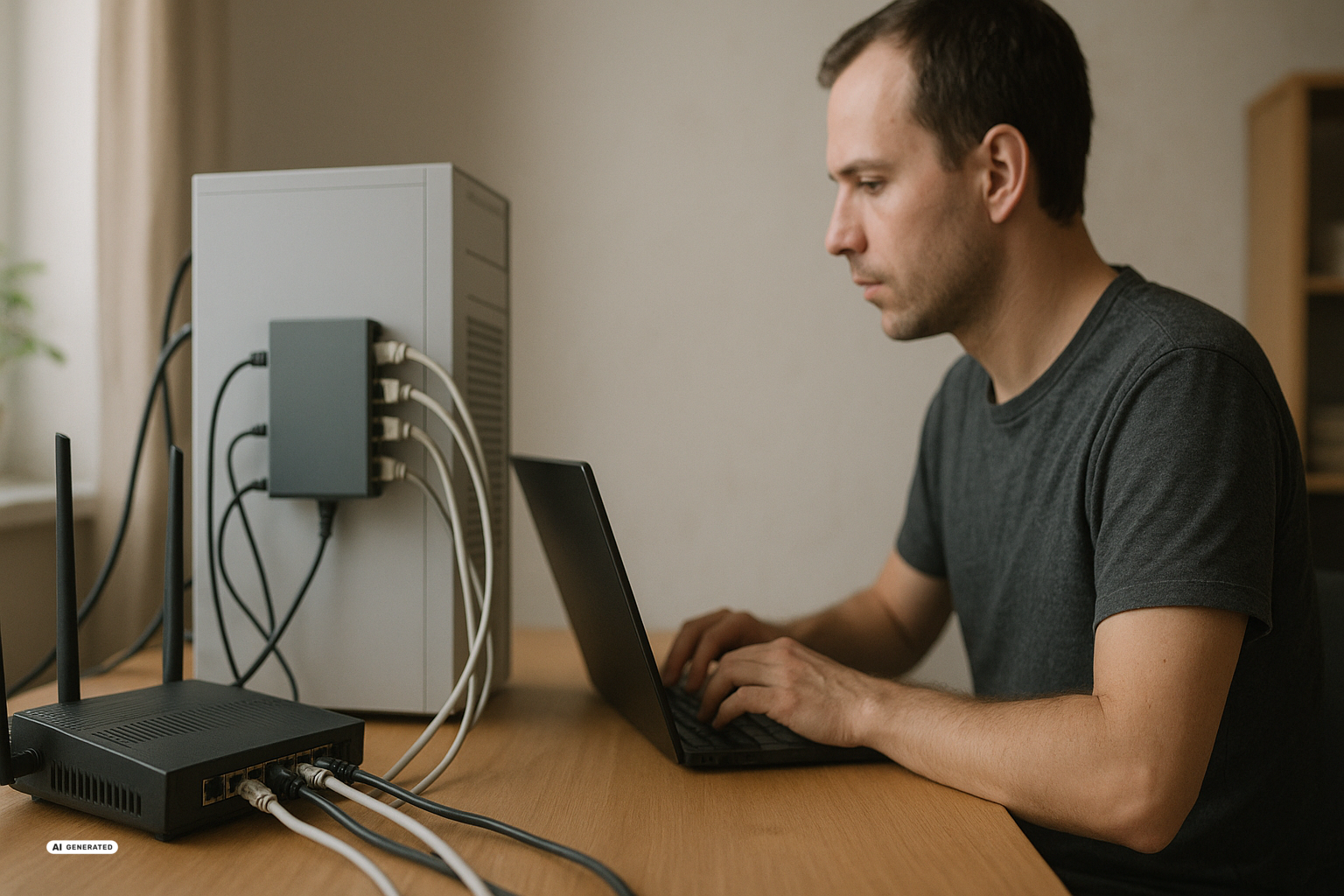
Nvidia PAIR distributes local Artificial Intelligence (AI) requests across multiple compatible computers on your home network. The free, open-source tool is primarily aimed at technically curious users who do not want to run models and automated agents exclusively in the cloud. The approach matters because desktops, laptops, and compact AI computers can contribute their processing power together instead of operating as isolated machines.
Why local AI matters
Local AI processes data on nearby devices rather than sending every request to an outside cloud service. This can keep sensitive material inside your own network and reduce dependence on internet connections or recurring cloud subscriptions. Whether processing remains entirely local still depends on every application and service involved, not only on the model itself.
PAIR stands for Personal AI Router. Despite the name, it is not a physical router but software that discovers compatible computers on a network and assigns work to them. According to The Verge’s report on Nvidia’s free tool, PAIR favors systems that are not currently occupied with other demanding tasks.
The concept is particularly relevant to agentic workflows. An AI agent is software that divides a goal into individual steps and independently calls tools or additional specialized subagents to complete them. If five subagents search texts, analyze files, or handle separate parts of a job at the same time, a single graphics processing unit (GPU) can quickly become a bottleneck.
Local processing also extends well beyond home computers. Swiss research and technology center CSEM and Zurich electronics company Miromico have developed a compact radio node that analyzes audio, motion, and image data directly at industrial sensors. As Netzwoche reports on the Swiss sensor project, the system transmits only information classified as relevant, although CSEM provides no figures for the actual reductions in energy use or data traffic.
What PAIR improves
PAIR acts as a virtual intermediary between applications and existing model tools such as Ollama or LM Studio. Inference means generating an answer with an already trained model. Applications are intended to keep using their existing endpoints while PAIR selects a suitable computer in the background and returns the combined results.
According to a technical summary of PAIR, its scheduler considers whether a device is ready, has the exact model required, how many jobs it is handling, and how heavily its GPU is being used. This does not make every kind of workload faster. The main benefit appears when several independent requests can run in parallel.
In Nvidia’s demonstration, a task involving five subagents took an average of 18 minutes on one RTX Spark laptop. A three-device cluster completed it in 8 minutes and 48 seconds, which other coverage rounds to just under nine minutes. Nvidia reportedly describes this demonstration as unofficial rather than a benchmark, meaning it is not a standardized, independently comparable performance test; the result is therefore a vendor example, not general proof of speed.
PAIR supports GeForce RTX graphics cards from the 20 series onward, RTX Pro workstations, DGX Spark systems, and Apple chips starting with the M4. The beta is available for Windows, macOS, and Linux, according to the initial report on PAIR. Devices are paired with a six-digit code, while traffic between them is protected by Mutual Transport Layer Security (mTLS), a method that authenticates both sides and encrypts the connection.
PAIR is also designed to adapt when a computer leaves the network or suddenly needs its resources for something else. If someone starts a game on the desktop, for example, the software can reassess its available capacity and direct further jobs to other devices. That will not prevent every interruption, but it makes the cluster more flexible than a fixed assignment of machines.
Where local agents become practical
A substantial document task is one straightforward example. Several subagents could inspect different files in parallel, combine their findings, and then produce a response instead of completing every step sequentially on one laptop. Nvidia’s five-agent test does not establish performance for every type of document, but it illustrates this form of parallel work.
A second example comes from the connected home. Ugreen’s HomeAgent combines network-attached storage (NAS), meaning a storage device available through your network, with camera recording, device controls, and a local voice assistant. The system is intended to identify people, vehicles, pets, and packages in camera footage, search recorded events, or answer where a pet was last seen.
The report on Ugreen’s local smart-home platform also illustrates the cost question. Announced prices range from an $899 early-bird price for the HA100 to $2,999 for the HA100 Pro and $9,999 for the Nvidia-based MA100. Monthly storage charges are supposed to disappear, but the upfront cost can be substantial; the report also describes the system as “local-first” with caveats despite the promise of local processing.
Nvidia is expanding the broader ecosystem around local AI as well. The company announced simpler local support for several agent tools, new compact RTX Spark PCs, and llama.cpp and vLLM optimizations that, according to the provider, can deliver up to 1.9 times faster local inference. These claims in Nvidia’s IFA 2026 post are vendor figures and should not be treated as the same measurement as the three-device PAIR demonstration.
Pros and Cons of local agent clusters
Pros:
- Greater privacy – Documents, camera footage, and sensor data can stay within the local system, provided no participating application also sends them to a cloud service.
- Parallel processing – Several available devices can handle separate agent tasks at once and reduce waiting times compared with one overloaded computer.
- Use of existing hardware – A compatible gaming desktop, laptop, and additional AI computer can form a shared pool instead of placing every job on one system.
- Fewer recurring fees – Local models and storage may replace some cloud or storage subscriptions, although hardware and electricity are not free.
Cons:
- Limited compatibility – PAIR supports particular Nvidia GPUs and newer Apple chips, so older or different devices do not automatically become part of the cluster.
- Unverified performance – The published reduction in runtime comes from an Nvidia demonstration and is explicitly not a standardized benchmark.
- Technical overhead – Local models, suitable model tools, and correctly paired computers require more effort than using a ready-made cloud chatbot.
- Purchase and operating costs – Existing machines lower the entry cost, but extra hardware and its electricity use can reduce the financial advantage.
What this means for you
If you are a beginner, first check whether you have a suitable task and compatible hardware. One supported computer running Ollama or LM Studio is a more sensible starting point than immediately building a multi-device cluster. PAIR becomes worth evaluating once you regularly run several independent jobs at the same time and one machine has become the bottleneck.
More advanced users can gain additional value by distributing specialized subagents. You might reserve one computer for document analysis while other systems handle further model requests, provided the exact model required is present on each relevant node. Comparing the same task on one device and on the cluster is useful because Nvidia’s demonstration does not guarantee the same improvement in your workflow.
For Switzerland, the edge approach is relevant alongside PAIR. Edge AI means processing data where it is created; the CSEM and Miromico project demonstrates this with pumps, conveyor belts, and production machinery, where unusual sounds or motion patterns can be detected locally. The supplied sources do not specify special Swiss availability for PAIR, supported interface languages, or compliance with particular Swiss data-protection requirements.
PAIR does not merge several compatible devices into one faster supercomputer; it distributes separable jobs among available machines. That can improve privacy and response times when the hardware already exists and the workflow contains enough parallel tasks. The open risk is how reliably the beta performs on typical home networks and whether the vendor’s results can be reproduced outside selected demonstrations.
Sources
- Nvidia PAIR: Open-Source-Tool macht das Heimnetzwerk zum KI-Cluster – The Decoder, 2026-09-04
- NVIDIA Releases Personal AI Router (PAIR) – MarkTechPost, 2026-09-05
- Nvidia launches free tool that links idle computers into a personal AI data center – The Verge, 2026-09-03
- Sparks Fly: NVIDIA Accelerates Local AI at IFA 2026 – NVIDIA Blog, 2026-09-03
- This NAS company wants to run your local smart home – The Verge, 2026-09-04
- CSEM und Miromico bringen KI direkt an Industriesensoren – Netzwoche, 2026-09-03