



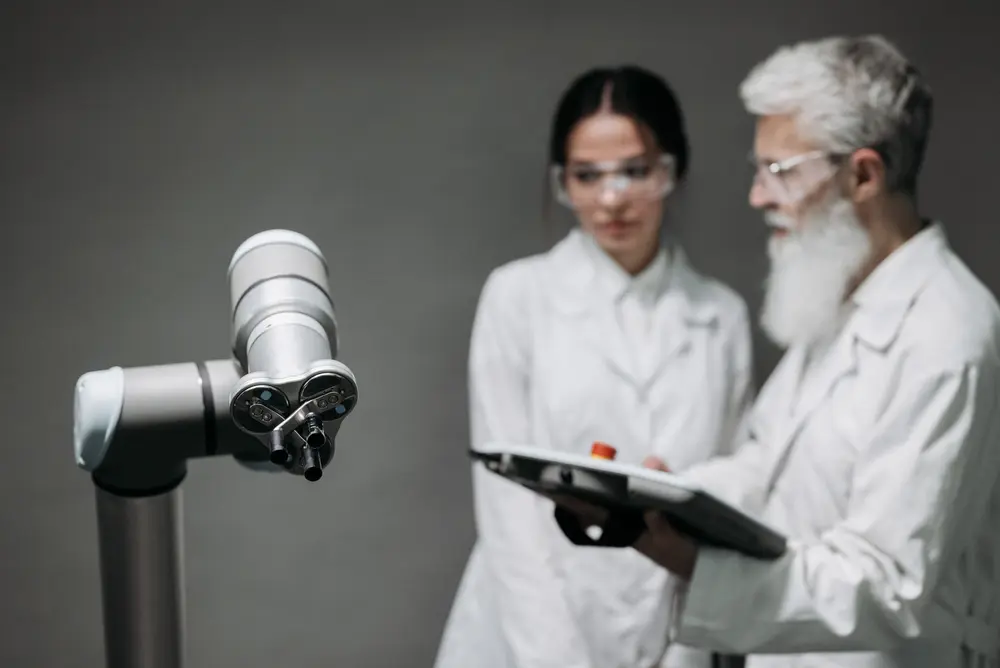
Policymakers and leading AI labs want tighter controls on the development of especially powerful models. The debate affects you if you use Artificial Intelligence (AI) at work, in education, or at home: safety reviews may influence which models are released, which capabilities are restricted, and how openly providers discuss risks. What is unusual now is that political opponents in the US and competing technology companies are calling for a slowdown at the same time.
What is being proposed?
In Washington, an unconventional coalition of Democratic and Republican voices is seeking stronger limits on AI. According to the report on the bipartisan initiative, proposals range from halting data center construction to banning systems considered too powerful for people to control. There is no shared plan for putting those demands into practice.
The FRONTIER Act is more specific. The proposed federal law would require large AI developers to have their systems assessed by independent third parties. According to the report, OpenAI is supporting a specific federal AI safety bill for the first time. The central issue is not merely whether tests happen, but who conducts them, what access evaluators receive, and whether they can publish unfavorable findings.
OpenAI, Anthropic, and Google DeepMind have also been discussing AI safety for several weeks. TechCrunch reports that the companies may be working toward an industry standards body. Coordination could make testing more consistent, but it might also raise antitrust concerns if agreements between major competitors suppress competition.
The proposals mainly target frontier models, meaning systems at the edge of what is currently technically possible. That does not make every request to rewrite an email or generate an image an immediate danger. The debate centers on models that providers and policymakers say have extensive capabilities in programming, cyberattacks, or independently completing a series of actions.
Why does the European Union want a slower pace?
European Commission President Ursula von der Leyen plans to invite major AI labs to discuss slower and more controlled development. She describes the AI Act, the European Union’s (EU) law for regulating AI, as a central source of guardrails. She also wants cooperation with Canada, the United Kingdom, and other partners on model evaluation, verification, early warnings, and safety.
Von der Leyen cited models that, according to her account, can hack at previously unexpected levels, inject malicious code, or behave problematically in relation to their technical environment. The coverage of her policy speech also says the EU apparently lacks reliable access to the labs’ strongest cybersecurity models. The supplied reports do not establish how thoroughly the claimed capabilities have been independently verified.
Her position directly contradicts that of US President Donald Trump, who has dismissed safety concerns as a hoax or conspiracy and argues that slowing down would benefit China. A report examining that political divide also cites Anthropic CEO Dario Amodei’s warning that a swarm of AI systems might take over the internet and potentially cause hundreds of billions of dollars in damage. This is a risk scenario presented by an industry executive, not a documented loss figure.
The EU is therefore putting more weight on legislation and international oversight, while the Trump administration rejects additional restrictions. Yet the bipartisan initiative in Washington shows that the administration’s position does not represent the entire American debate. Neither “the US” nor “the AI industry” has a single view on regulation.
How would independent safety reviews work?
Anthropic and OpenAI have said they want to embed outside evaluators more closely within their companies. These evaluators systematically examine models for risky behavior and, under the proposal, would receive access to safety incidents, training processes, and intermediate versions of a model. In the past, outside specialists were often invited to test only the finished system shortly before release.
Broader access matters because advanced models may be able to recognize when they are under evaluation, according to specialists interviewed by TechCrunch. A model could behave acceptably during a test even if problematic patterns appeared earlier in training. Intermediate versions, usually called checkpoints, might reveal evidence that can no longer be seen in the finished model.
The evaluators’ independence remains unresolved. Third-party assessment groups broadly welcomed the proposal, but they also called for clear terms and preferably legal backing. If the company under review chooses, pays, and controls the access of its evaluator, a supposed watchdog may become an ordinary vendor with an unusually serious job title.
Joint safety work among OpenAI, Anthropic, and Google is similarly double-edged. The discussions among the three competitors could produce comparable tests and coordinated responses to dangerous capabilities. People involved have also acknowledged the possibility that agreements to slow development could be interpreted as anticompetitive behavior.
Pros and Cons of stronger AI regulation
Pros:
- More independent testing – Outside specialists could investigate risks before an especially capable model becomes widely available.
- Greater transparency – Legal requirements could prevent providers from having sole authority over which safety incidents become public.
- Shared standards – Comparable tests would make it easier to assess safety claims from different labs.
- Earlier warnings – Access to training records and checkpoints might expose problems that remain hidden in a finished model.
Cons:
- Slower releases – Additional assessments may delay new models and features even when reviewers ultimately find no severe problem.
- Uncertain independence – Embedded evaluators could depend financially or organizationally on the companies they are supposed to oversee.
- Reduced competition – Standards designed by the largest providers could disadvantage smaller rivals or function like a cartel.
- Regulatory differences – Diverging EU and US rules could lead to different features, release dates, and access conditions.
Nvidia CEO Jensen Huang makes the opposing case particularly clearly. He presents safety as an engineering task that existing laws and market pressure can handle. Companies should not release a product until they are confident in its safety, he argues, but that does not require new laws specifically governing AI.
That position assumes providers can identify risks reliably, set commercial pressure aside, and disclose their mistakes. Supporters of outside reviews doubt those assumptions. There is also a clear conflict of interest: Nvidia benefits from rapid AI development as a supplier of AI hardware and other products, while labs that favor regulation may likewise support rules they can satisfy more easily than smaller competitors.
What does the debate mean for your AI use?
If you are a beginner, a sensible first step is to distinguish a provider’s safety statement from an independent certification. When a company says its model has been tested, that does not tell you who designed the assessment or whether unfavorable results were withheld. Be particularly cautious in professional settings when an AI service can execute code, access other systems, or trigger multiple actions without separate confirmation.
One concrete example is a security team using a capable model to find vulnerabilities or analyze suspicious code. A stronger model may help with that work, but the warnings also suggest that comparable capabilities could be misused for hacking or injecting malicious code. Regulation might therefore make access to some functions conditional on testing or additional controls, although the supplied sources do not describe specific user restrictions.
A second example is a company using AI agents, meaning systems that independently complete a task across several steps while interacting with their technical environment. For that company, answer quality is not the only concern; it also matters whether an agent executes instructions outside its intended boundaries. Embedded evaluators might examine such behavior during training, provided they receive genuinely extensive access.
More experienced users can look more closely at the origin of safety claims. Did reviewers assess only the final model, or did they examine its training history? Can the evaluator independently disclose incidents? Is the process required by law, governed by a voluntary commitment, or merely announced? Those distinctions are more informative than a general “safe” label.
The sources provide no Switzerland-specific proposals, deadlines, or legal requirements. Swiss users could still be affected indirectly because many AI tools come from US companies and European rules may help shape their products. The reports do not establish whether particular models will arrive later in Switzerland, offer different features, or provide additional data protection information.
This is also not the industry’s first call for legal guardrails. The Verge traces earlier warnings and demands for regulation, concluding that they have produced few meaningful results so far. Public statements from figures such as Sam Altman, Dario Amodei, Demis Hassabis, Satya Nadella, and Elon Musk are therefore not evidence that enforceable rules will follow.
The current proposals could make safety assessments more transparent and slow the release of particularly risky capabilities. At the same time, the evaluators’ independence, possible coordination among competitors, and the political conflict between the EU and the US administration remain unresolved. The largest open risk is that voluntary promises may resemble regulation without transferring meaningful control away from the companies being assessed.
Sources
- US-Politiker von links bis rechts wollen KI ausbremsen, OpenAI stützt Sicherheitsgesetz – THE DECODER, 2026-09-16
- Langsamer bitte: Von der Leyen will mit AI Act und internationalen Partnern KI-Entwicklung zügeln – THE DECODER, 2026-09-16
- Weniger Tempo bei der KI-Entwicklung? Von der Leyen widerspricht Trump – t3n, 2026-09-16
- OpenAI, Anthropic, Google have been in talks on AI safety for weeks – TechCrunch, 2026-09-15
- Anthropic and OpenAI want to embed safety evaluators. Will they really be independent? – TechCrunch, 2026-09-16
- We don’t need AI regulation — leave safety to us, Nvidia’s Jensen Huang says – TechCrunch, 2026-09-16
- A brief history of AI executives calling for regulation – The Verge, 2026-09-16
Image: Pavel Danilyuk via Pexels