



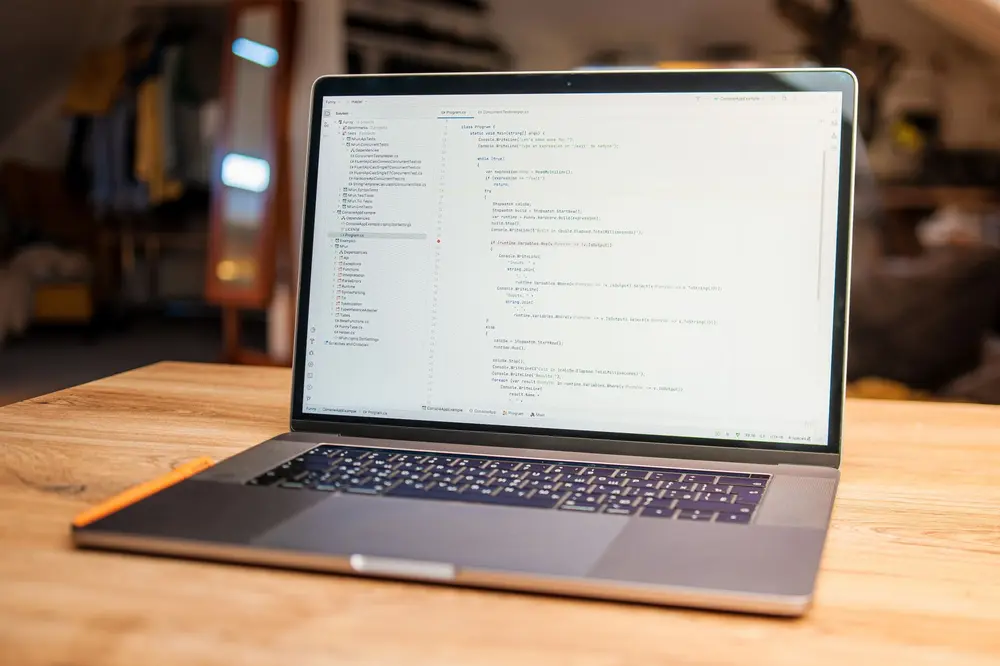
Flint is a free Artificial Intelligence (AI) model designed to analyze, modify, and test software code on a laptop. At the same time, new open tools aim to resume coding agents after crashes or lower the operating costs of self-hosted models. This mainly affects software developers and smaller organizations that would rather not send their source code to a cloud service for every request.
Local models as a starting point
A coding agent is an AI system that can do more than suggest code: it can carry out a sequence of actions involving files and software tools. According to Recursive’s introduction of Flint, the model can run on your own computer, work offline, and process code locally. This also removes the usage charges that cloud services typically base on the amount of text processed.
Flint uses a mixture-of-experts (MoE) design, meaning that it activates only a selection of specialized model components for each task. It contains almost 40 billion parameters, the learned values that shape a model’s behavior, but uses about 2.5 billion for each processed piece of text. This arrangement is intended to make a relatively large model practical on hardware outside a data center.
Local does not mean undemanding. The technical overview of Flint lists Apple Silicon Macs with 48 gigabytes of memory or Nvidia graphics hardware with the same amount. Its four-bit weights, which store the model’s numerical values in a compressed format, reportedly occupy about 23 gigabytes.
Recursive reports roughly 131 tokens per second on a MacBook Pro with an M4 Pro chip. Tokens are short text units from which a model constructs its input and output. On SWE-bench Verified, a benchmark based on real software bugs, Flint scored 74.2 percent according to the additional report and led other MoE models below 50 billion parameters in Recursive’s agentic coding comparison. These figures come from the provider or presentations based on its testing and have not been independently verified in the supplied sources.
The description of Flint as open also needs some nuance. TechCrunch calls it open source, while the technical report uses the more specific term open-weight, meaning that the model’s learned weights are available. Both accounts say the weights are provided under the Apache 2.0 license and can be used and modified without charge; the sources do not establish whether all training data and development steps have been disclosed.
AI building AI under human supervision
Recursive says it developed Flint in less than four months with extensive help from an automated research system called the Eureka Machine. The system proposed ideas, implemented them, tested the results, and selected what to try next. According to the company, it contributed to almost every development stage while a small human team supervised the process.
This is a limited example of recursive self-improvement, the idea that AI can help build better AI. Flint was not produced by an unconstrained system rewriting itself, but by a research assistant operating within a process overseen by people. Even so, the quality of human review remains relevant when designs, tests, and experimental choices are generated automatically.
For practical work, Flint is intended to inspect codebases, fix bugs, implement features, and write tests. One example would be a local project where the agent searches for the cause of a reported defect, edits the affected files, and adds relevant tests. Another would be implementing a feature across several files without transmitting the entire codebase to an outside model provider at each step.
Performance is not consistent across every type of task. MarkTechPost reports a strong 95.1 percent result for instruction following, but Flint reached 54.9 percent on Terminal-Bench 2.1, compared with 73.0 percent for the dense Qwen model cited there. A dense model activates all of its model components rather than a selected set, so Flint’s higher local speed does not automatically make it the strongest option for every job.
Crash resilience for longer tasks
A fast local model does not solve the problem of interrupted agent sessions. Coding agents often perform a chain of model requests and tool calls, where a tool call might read a file or launch a test. If the process crashes or a session reaches its time limit, the accumulated state can be lost.
Vercel has released durable-harness as an open-source package to address this issue. According to the available summary, it records every model and tool call so sessions involving Pi, OpenCode, Claude Code, and Codex can resume after crashes, timeouts, or redeployments. The state can reportedly be stored on Vercel, in a PostgreSQL database, or on a laptop.
This is less eye-catching than a new model but may be more immediately useful in everyday work. If an agent spends an extended period investigating a bug and the laptop restarts, the session should not necessarily have to begin again from scratch. “Crash-proof” should not be confused with error-free, however: preserving the state does not guarantee that the agent’s previous changes were correct.
Flint and durable-harness therefore address different parts of the same workflow. Flint supplies a model for local code work, while durable-harness aims to make the process surrounding a model more resilient. The sources do not demonstrate a fully tested, ready-made setup in which the two have already been integrated.
Lower-cost inference beyond the laptop
Inference is the operation of a trained model as it processes requests and generates responses. On one laptop, the cost question mainly concerns available hardware and power consumption, but the sources provide no specific amounts. When many people use a model at once, efficient text generation, workload distribution, and hardware utilization become more significant.
DeepSeek has released its internal DeepInfer operating software under the Apache 2.0 license. According to the report on DeepInfer’s release, the framework is based on vLLM, software for running large language models efficiently. It includes optimized computing components, distributes work across multiple chips, and is intended to accelerate text generation.
DeepInfer is not aimed at people who only use DeepSeek through its website or app. It is intended for organizations operating models themselves and trying to reduce computing and energy costs. T3N likewise describes the tool as infrastructure for self-hosting; the sources do not show how large the savings would be in a particular installation.
DeepSeek has also released a component called deepseek-recipe. It is meant to reproduce the token processing of the official application programming interface, helping self-hosted installations behave more consistently. The company says code for future models will also be released, though this remains a provider commitment rather than an independently established result.
For larger deployments, Google, Red Hat, and IBM have released llm-d 1.0 in parallel. The open distributed inference stack llm-d is built around Kubernetes, a platform used to manage software services across multiple machines. Its listed features include flow control for multiple tenants, upgrades without downtime, and agent-aware request routing across vLLM, SGLang, graphics processing units, and Tensor Processing Units (TPUs), Google’s specialized AI chips.
The reports therefore cover three different scales: Flint targets a capable laptop, DeepInfer targets more efficient self-hosting, and llm-d targets distributed infrastructure. These tools are not direct substitutes. If you work locally on one project, you are unlikely to need a Kubernetes cluster; if you serve a model to many teams, one laptop is unlikely to be sufficient.
Pros and Cons of local coding agents
Pros:
- Local data handling – Flint can process code on your own computer, so according to the provider it does not need to send every request to a cloud model server.
- More predictable usage – Local operation avoids model fees based on text volume, although hardware and electricity still have costs.
- Resumable work – durable-harness is designed to continue longer sessions after crashes, timeouts, or redeployments.
- Open modification – Flint and DeepInfer are available under Apache 2.0, allowing use and modification under that license.
Cons:
- Substantial hardware requirement – The stated Flint configuration requires 48 gigabytes of memory, which is beyond many ordinary laptops.
- Uneven performance – Strong results on some tests do not prevent Flint from trailing more capable models on demanding terminal tasks.
- More responsibility – Local or self-managed operation shifts setup, updates, and oversight to the person or organization running the system.
- Unverified savings – DeepInfer is intended to reduce computing and energy costs, but the sources provide no independent measurements or specific amounts.
What this means for you
If you are a beginner, first define the task you want to solve and check whether your hardware meets the stated requirements. A sensible initial test is a copied or otherwise protected project with a narrow assignment, such as investigating a known bug and proposing tests. This lets you assess output quality and speed without immediately giving an agent broad control over an important working project.
If you are an advanced user, you can evaluate the model, the agent workflow, and session recovery separately. You can test whether Flint is sufficient for your typical codebases, whether durable-harness resumes long sessions reliably, and whether a shared deployment calls for DeepInfer or a distributed option such as llm-d. Your own repeatable tasks will be especially informative because the published benchmarks cannot represent every programming language and project.
For Switzerland, local operation is the most relevant aspect: according to the provider, source code can remain on your own computer, and the reports mention no geographic availability restrictions. The sources do not address German-language operation, Swiss data protection requirements, or support from local providers. Local execution can therefore give you more technical control over sensitive business or education data, but it does not automatically guarantee compliant operation.
These tools shift coding agents away from isolated cloud services and toward a more open chain consisting of a local model, durable session state, and efficient inference. Flint is the most tangible entry point, while DeepInfer and llm-d are aimed more at infrastructure for larger deployments. The main unresolved issues are independent confirmation of performance and savings, along with the reliability of automatically generated code changes in real projects.
Sources
- Recursive launches Flint, a laptop coding model it says was largely built by AI – Unknown, 2026-10-21
- Recursive Releases Flint, an Open-Weight 40B MoE Local Coding Model for Agents with 2.5B Active Params – Unknown, 2026-10-21
- Vercel Open-Sources durable-harness for Crash-Proof Coding Agents – Unknown, 2026-10-21
- Deepseek: Dieses quelloffene Tool soll KI-Kosten reduzieren – für wen es gedacht ist – Unknown, 2026-10-21
- DeepInfer: Deepseek gibt die Betriebssoftware hinter seinem schnellen KI-Modell frei – Unknown, 2026-10-20
- Google Cloud Ships llm-d 1.0 With Cache-Aware Routing for TPU and GPU Fleets – Unknown, 2026-10-21


Image: Daniil Komov via Pexels