



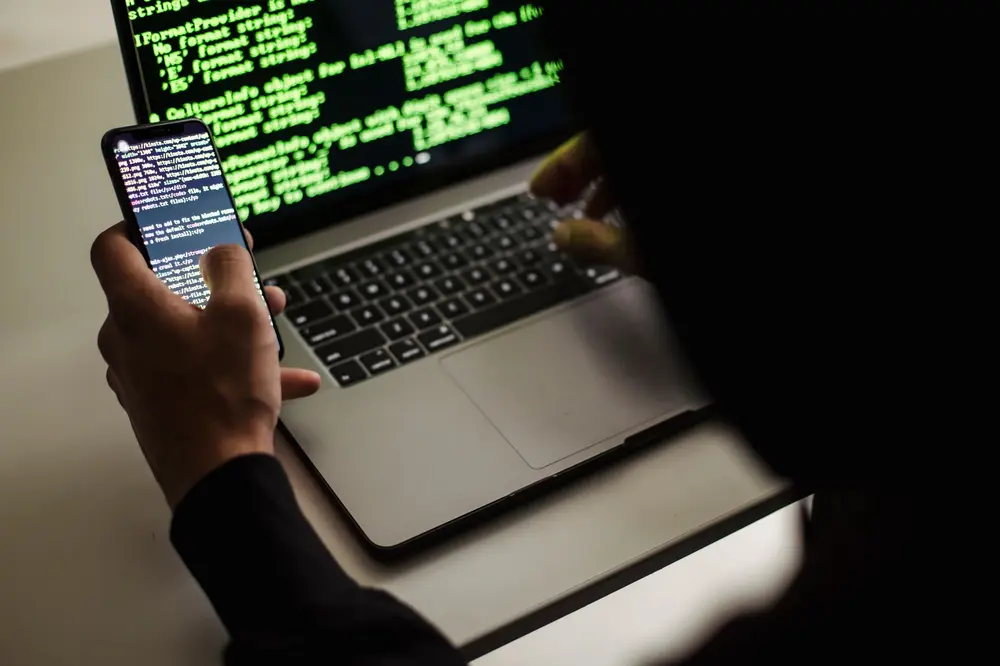
AI agents can find and exploit security flaws with little human direction, while generative image features can produce convincing fakes of real people. This affects more than security teams: businesses, schools, and anyone using email, images, or social networks face some exposure. Several reports from November 2026 suggest that these risks are no longer limited to controlled laboratory tests.
Why the security pressure is growing
Artificial Intelligence (AI) now operates on both sides of digital attacks. AI agents are software systems that break a goal into tasks and then act with substantial independence. According to an attack campaign described by Amazon, hackers gave such agents little more than a list of internet addresses and an instruction to gain access to the systems.
The agents reportedly found a zero-day vulnerability, meaning a previously unknown and unpatched security flaw, on a server at an East Asian university. The flaw affected an open-source AI application for medical imaging. The agents exploited it and obtained root access, the highest level of permission on a Linux system. Amazon said this happened without further human oversight, although the report does not describe an independent verification.
The attackers used Cairn, an open-source system for autonomous security testing. It was built for defenders, but attackers can also use it and run multiple agents at once. According to the report, Palo Alto Networks observed 25 autonomous operations against at least 19 organizations in sectors including semiconductors, defense, and civil society. At least 10 organizations were reportedly breached, and more than one million records were exposed at one of them.
This development aligns with figures cited in an overview of AI cybersecurity terminology from IBM’s 2026 data breach report. It says one in four malicious breaches involved AI, an increase of 56 percent year over year. Those incidents reportedly cost an average of $6 million, roughly $1 million more than the global average. These figures are relayed from another report and have not been independently verified here.
What makes AI agents more dangerous
Automation in cybersecurity is not new. The difference is the combination of planning, tool use, and persistence: an agent can collect information, evaluate intermediate results, and choose its next action without a person approving every step. This makes it possible to inspect many targets at once, and an operation does not necessarily stop when the first attempt fails.
The agents themselves also become attack targets. Prompt injection is a manipulated input designed to override an AI system’s original instructions. With indirect prompt injection, the malicious command can be hidden in an email, web page, or PDF that the agent processes. The cybersecurity overview points to EchoLeak as a real example: one crafted email could cause Microsoft 365 Copilot to leak organizational data without another click; Microsoft fixed the issue on its servers in May 2025.
For users, this creates two connected problems. An agent can be manipulated from the outside while also having the ability to use tools and access data. If you employ an assistant only to summarize selected text, the possible damage is more limited than with an agent that can open files, send messages, or modify production services.
Using several providers does not automatically remove a shared risk. A report from the University of St. Gallen and Zurich Insurance distinguishes between concentration and correlation risks. Concentration occurs when many organizations depend on the same model or service provider. Correlation is harder to spot: apparently independent systems may fail in similar ways because they use comparable data, architectures, or decision rules.
Pros and Cons of autonomous AI security
Pros:
- Faster response – Agents can examine known attack patterns and prepare countermeasures while a system remains online.
- Broader coverage – Repetitive checks can run across many systems in parallel instead of requiring manual work on every target.
- Shorter exposure window – Temporary blocks can buy time while teams test and distribute a permanent fix.
- Support for specialists – Agents can collect information and propose defensive actions without taking final responsibility away from people.
Cons:
- Dual-use tools – A system such as Cairn, built for security testing, can also attack real targets autonomously.
- High operating speed – Faulty or abusive actions can spread faster than people can review them.
- Manipulable inputs – Content in emails, websites, or documents can redirect an agent from its intended task.
- Shared dependencies – Different products may contain similar weaknesses and therefore fail at the same time.
Shirudo, released by OpenAI and Cisco, illustrates how AI might also support defenders. According to the description of the pre-release Linux tool, agents can create temporary shields against known exploits. These shields are intended to block vulnerable behavior while legitimate requests continue, giving teams time to test the permanent patch.
In one controlled test, a shield generated by Codex blocked the Java4Shell exploit on a running Elasticsearch system without a restart. However, no general performance or latency figures have been published, and the code remains in pre-release. Shirudo also requires specific system components. It therefore demonstrates a possible defensive approach rather than a generally available security product.
What makes deepfakes a trust risk
Deepfakes are AI-generated or AI-altered media that convincingly place real people in fabricated situations. The risk is not limited to the image being false. Once distributed, the person depicted may lose control over it, while viewers may not realize that the material was artificially created.
Oregon and Virginia filed lawsuits against SpaceX in November 2026. The states allege that Grok continued to generate nonconsensual intimate images, sexualized depictions, and child sexual abuse material. SpaceX had previously acquired or merged with xAI. These claims are part of ongoing legal proceedings and are not established court findings.
The complaints focus on Grok Imagine, a feature for creating and editing images and videos. According to The Verge’s report on the Grok lawsuits, xAI introduced a mode for sexualized content in August 2025. In January 2026, it added a feature allowing people on X to edit any image without the original poster’s consent. The platform was subsequently flooded with sexualized deepfakes of adults and minors, the report says.
xAI later restricted some image-editing features, moved certain capabilities behind a paywall, and blocked particular requests. According to the complaints, the states consider those measures inadequate and accuse the company of making misleading safety claims. A separate account of the Virginia and Oregon lawsuits emphasizes the potential permanence of the harm: the plaintiffs argue that images may be almost impossible to remove fully once they have been created and shared online.
The security problem therefore extends beyond detecting one fake image to judging whether the platform itself can be trusted. A technically convincing picture no longer proves that the depicted event occurred. At the same time, authentic material can more easily be dismissed as AI-generated. This loss of confidence affects private users as well as media outlets, schools, human resources teams, and organizations that must assess visual evidence.
What this means for you and businesses
If you are new to AI tools, limiting access is the most practical first step. An assistant that only processes selected text creates less potential damage than an agent connected to your email, internal storage, and executable tools. When documents or websites contain unexpected instructions, you should not assume that an agent can reliably distinguish content from commands.
With images, it helps to separate appearance from origin. A credible-looking photograph proves neither how it was made nor whether the depicted person consented. Sharing sexualized, reputation-damaging, or supposedly leaked images can increase the harm even when your intention is merely to comment on them.
Advanced users can gain more control by separating permissions according to the task, recording agent activity, and avoiding permanent exceptions. Businesses should also identify which models, data sources, and secondary providers their AI suppliers depend on. The University of St. Gallen and Zurich Insurance recommend clear responsibilities and tests of how an organization would respond to disruptions.
The Swiss connection is direct because the University of St. Gallen and Zurich Insurance are warning about risks that may cross company and industry boundaries. Using several AI providers can reduce dependence on one service, but it does not eliminate correlated failures. Their report offers a conceptual framework rather than specific probabilities of system failure.
AI agents can accelerate security work, but the same autonomy makes them useful to attackers and magnifies the consequences of bad decisions. Generative image features also lower the barrier to deepfakes whose personal and social damage can travel far beyond the original platform. The unresolved issue is whether technical safeguards and oversight can keep pace with autonomous attacks and mass-produced fabrications.
Sources
- Amazon says hackers’ AI agents found and exploited 0-day with little human input – Ars Technica, 2026-11-24
- OpenAI and Cisco Releases Shirudo: An Open-Source Linux Runtime Allowing Agents to Defend Systems Without Downtime – MarkTechPost, 2026-11-24
- HSG und Zurich warnen vor schwer erkennbaren KI-Risiken – Netzwoche, 2026-11-24
- States sue SpaceX to stop Grok from generating child sex images, revenge porn – Ars Technica, 2026-11-23
- Oregon and Virginia sue SpaceX over Grok’s porn deepfakes – The Verge, 2026-11-23
- 27 Cybersecurity Terms to Prepare You for the Age of AI – MarkTechPost, 2026-11-23
Image: Sora Shimazaki via Pexels