



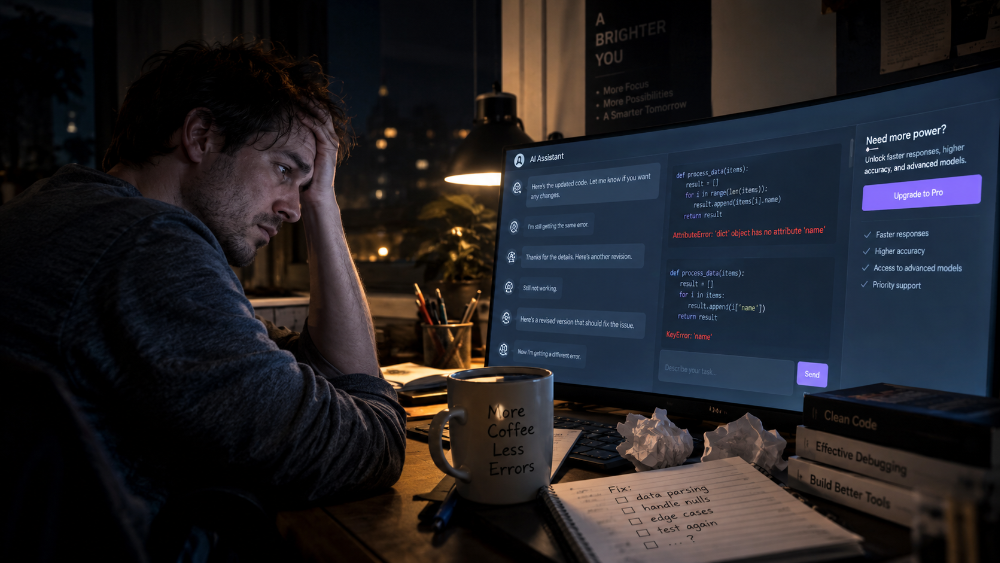
Pro, Just This Once. So This Can Finally Be Over.
I’ve been working with an AI for quite some time. It offers different models and settings that let me choose how long and how thoroughly it thinks about a task. Pro is presented as the best option, but its use is limited. Once you reach that limit, you have to pay for more. That’s why I don’t use Pro. I use the “very high” setting. It consistently gives me good results and lets me make progress on my projects. One of those projects involves programming. Code that needs to do more than look convincing. It needs to work.
Then an upgrade arrives. A new, absolutely brilliant reasoning model that is supposed to leave every previous model in the dust. Allegedly. Available to try in Pro mode. The interesting part is what I start noticing in the setting I’ve been using all along. The results still look good at first. The explanations sound convincing. Everything seems to fit. Except the code suddenly keeps having these “little” errors. Not matters of personal preference, but identifiable bugs that stop things from working. So I explain the error. The AI corrects it. I test it. Something is wrong again. So I explain it again, have it corrected, and test it again. Working on the project turns into an almost endless back-and-forth over things that should have been working long ago. This wasn’t my experience immediately before the new super-duper model was released. Well. Maybe it’s my subjective perception. Maybe there’s a technical explanation I’m unaware of. I can identify the individual errors. What I don’t know is why I’m suddenly encountering so many of them. Eventually, though, I think: Fine. I’ll use Pro for this one task. Not because I’m desperate to try the latest thing. I just want to make progress instead of going round in circles.
At the same time, I’m working on another project. This one involves a running order for a presentation. That, too, had worked without any problems on “very high”. But now, things keep getting misunderstood. Nothing dramatic, I tell myself at first. I explain that particular detail again, and we move on. Except it doesn’t stop at that one detail. I explain, clarify and correct. Again and again. Until, even with this comparatively simple task, I catch myself thinking: Hmm. Should I just use Pro once so this can finally be over?
And that is when I realise just how insidious the design of a system like this could be. Nobody would even have to convince me that I needed something better. It might be enough for what had been perfectly adequate to suddenly become so frustrating that I started looking for the paid way out myself. I wouldn’t switch out of excitement. I’d switch because I’d had enough of the correction loops. Of course, just once. Just for this task. Just so I could finally get back to work. And for the next task? Once more? And then again? Until I got used to the idea that making any meaningful progress simply requires Pro? Perhaps I would eventually start explaining it that way myself: “Very high” just isn’t enough anymore. The new model is simply so much better. Meanwhile, I would have lost sight of the other question: Why is something that was good enough just a little while ago suddenly no longer enough? Maybe the new super-duper mode wouldn’t have to be brilliantly perfect at all. Maybe it would be enough for the existing alternative to get worse at just the right moment.
Or consider another version of this thought experiment: It wasn’t deliberate at all. Just a small oversight. Somewhere, someone changed something in the wrong place. An employee, perhaps. Or an AI bot employee who had never existed as a human being in the first place. An unfortunate misconfiguration. Unfortunately, right in the middle of the new Pro model’s launch. And what if someone could prove that this change had happened? What if the whole thing came to light? Perhaps we would later read: “The employee responsible no longer works for our company.” Well then. Problem solved. Of course, that would leave unanswered whether this employee had ever existed, who had approved the change, and who had benefited from it in the meantime. But, for the moment, the story would have someone to blame and an ending.
The possibility of designing digital services to manipulate people is not merely an invention of this thought experiment. Under the term “dark commercial patterns”, the OECD describes practices that can steer, deceive or pressure users into decisions that are not in their interests.[1] That does not establish that an AI has been deliberately made worse. It simply shows that the broader question of manipulative design is legitimate.
I don’t know what lies behind my experience. I have no evidence that a provider deliberately made anything worse. But I did notice my own thought process: I suddenly wanted to use something I had previously chosen not to use. Not because the promised improvement had convinced me, but because I hoped it would make the problems go away.
Disclaimer: This article describes the author’s personal experiences and perceptions and expresses his opinions. The scenarios developed from those experiences concerning manipulative intentions, internal company procedures and responsible employees are hypothetical and exaggerated for satirical effect. Any resemblance between these imagined scenarios or characters and actual events, real companies, or human or digital employees is not evidence that such events have actually occurred.
Perhaps you’ve experienced something similar. Something suddenly works less well, while a more expensive alternative is available. Think about it: What did you actually observe, and what are you merely assuming? Could small, barely noticeable changes gradually steer you towards a decision you had never intended to make? Not every decline in quality is manipulation. But how would you recognise it if it were?
References
[1] OECD. (2022). Dark commercial patterns (OECD Digital Economy Papers, No. 336). OECD Publishing. DOI: 10.1787/44f5e846-en. Access date: 6 September 2026. This source discusses manipulative digital design in general, not the specific AI experience described here.