



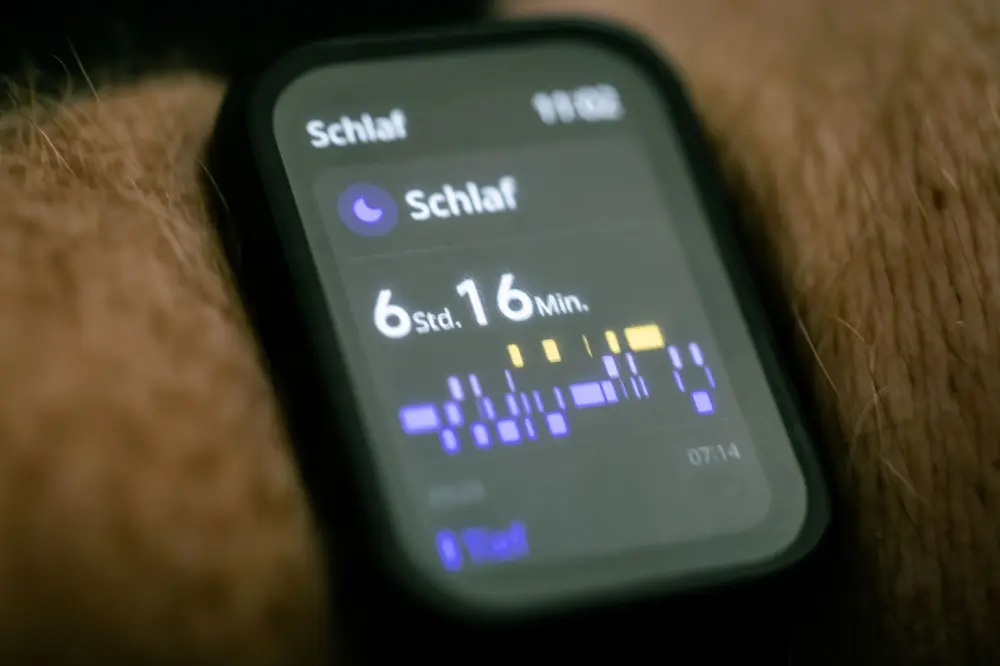
Samsung is adding Artificial Intelligence (AI) to sleep apnea detection on its Galaxy wearables, while Apple is launching a large study of how people use AI for health questions. This matters if you record sleep and activity with a watch or ring, or if you ask a chatbot about medical concerns. Both projects show how health data could move from passive tracking toward decision support—and why that still does not amount to a diagnosis.
Sleep apnea detection is becoming more detailed
Sleep apnea involves repeated pauses in breathing during sleep. It can lead to daytime fatigue and difficulty concentrating, and the lead report associates it with increased risks of conditions including type 2 diabetes, heart attacks, and depression. Samsung now plans to expand its detection system so that the Galaxy Watch and Galaxy Ring can, according to the company, classify breathing disturbances into three levels: mild, occasional, and frequent.
The analysis requires at least two nights of data within a ten-day period. You must wear the watch or ring for at least five hours on each of those nights. In practice, you could wear a compatible Galaxy Watch for two sufficiently long nights and receive not only an indication of possible breathing interruptions, but also a classification of how frequently they occurred.
Samsung’s expanded sleep apnea feature is scheduled to launch in South Korea in November 2026 for the Galaxy Watch Ultra 2, Galaxy Watch 9, and Galaxy Ring. The relevant US health authority cleared the feature in July 2026. There is no official European launch date yet, and the report says the necessary CE clearance is still pending.
The earlier sleep apnea feature has been available in Germany since June 2025 and has existed in some form since the Galaxy Watch 4. It remains unclear which older models will receive the new AI analysis. For users in Switzerland, neither availability nor a launch date has been confirmed.
Research measures sleep second by second
While Samsung is analyzing data from consumer devices, researchers are working with much more detailed brain signals. A team at Aachen University of Applied Sciences has developed AnySleep, an open-source AI model intended to analyze changes in brain activity one second at a time. Open source means the model is made available for inspection and further development.
Conventional classifications can miss brief changes within a longer period of sleep. AnySleep is designed to capture these transitions and distinguish sleep stages more precisely. According to the report, the findings were published in the journal npj Digital Medicine, and the model could eventually help identify patterns associated with particular diseases.
The second-by-second sleep analysis from Aachen is not the same as a smartwatch feature. The research model examines brain activity, whereas Samsung’s wearables are intended to provide an everyday indication of possible breathing disturbances. One may refine clinical sleep research; the other is designed to surface potential concerns outside a sleep laboratory.
A related Swiss research project shows how far brain-signal analysis may extend. A team at the Swiss Federal Institute of Technology Lausanne (EPFL) has developed LogSync, an implantable chip that examines electrical activity across several brain regions in real time. Machine learning, an AI method for recognizing patterns in data, is used to distinguish cognitive and emotional states and generate control signals for targeted brain stimulation.
The EPFL chip processes signals through 32 channels. So far, the researchers have tested it with existing brain data and in an animal experiment. That makes it relevant to Swiss research, but it is not an everyday product or evidence of successful use in humans.
Apple’s study tests health answers
Apple is not focusing on one measurement feature. Instead, it is studying conversational AI, meaning systems that answer questions written in everyday language. In partnership with health-focused AI company OpenEvidence, Apple is launching a study through a dedicated iPhone app. As many as 200,000 people are expected to ask medical questions for more than 12 months and rate the answers on criteria including accuracy, detail, and relevance.
The answers are intended to draw on clinical sources such as The New England Journal of Medicine, the Journal of the American Medical Association, and Nature. Participants will receive simplified explanations and links to peer-reviewed clinical sources, whose articles have been evaluated by specialists before publication. They can also provide feedback and will be asked to complete monthly surveys.
Preparing for a doctor’s appointment is one practical example. You could ask a health question and voluntarily share information such as resting heart rate, activity, sleep, or laboratory results from HealthKit. HealthKit is Apple’s framework for bringing together health information from different apps and devices. The app is meant to use that context for more personalized responses and direct people to appropriate providers when a medical issue appears concerning.
The reports from TechCrunch on Apple’s health study and The Verge on its study design conflict over the technical requirements. TechCrunch says participants need an iPhone 15 or later with Apple Intelligence enabled, while The Verge specifies an iPhone 15 Pro or later and explicitly says the app does not use Apple Intelligence. Both agree that participants must be at least 21 years old, live in the United States, and use iOS 26 or later.
According to the reports, Apple says data will be anonymized before being transferred to a secure third-party cloud provider and will not be used to train AI models. OpenEvidence is said to delete question-and-answer data after 24 hours. These are claims from the participating companies, and the supplied sources do not describe an independent audit of those privacy measures.
Pros and Cons of AI health data
Pros:
- Earlier indications – Wearables can monitor several nights for possible breathing disturbances and classify their frequency.
- More context – Voluntarily shared sleep, activity, and laboratory data can make answers more relevant to an individual situation.
- Clearer information – Apple’s study specifically tests whether clinically grounded answers are understandable and useful to participants.
- Support for care teams – AI can sort through extensive records while medical professionals review the evidence and make decisions.
Cons:
- No confirmed diagnosis – An alert from a watch or an answer from an app does not replace a medical examination.
- Limited availability – Samsung has not announced a European launch date, and Apple’s study is restricted to US participants.
- Sensitive information – Sleep data, laboratory results, and medical questions can reveal detailed information about personal health.
- Different levels of maturity – Consumer features, study apps, research models, and implantable chips are at very different stages of development.
Human review also remains central in professional healthcare settings. One system described by Nvidia searches clinicians’ notes, surgical reports, imaging findings, and laboratory results so care teams can locate relevant signals faster. In a Cleveland Clinic study, it was used to evaluate records from more than 7,800 people who had undergone aortic valve replacement; clinicians still reviewed the evidence and made every decision.
The Nvidia account of AI assisting care teams comes from a technology provider involved in the systems described, so its claims require that context. It also presents a different privacy model from Apple’s cloud-based study: Hospital records can be processed within a health system’s own firewall and, according to the provider, never leave the facility. The suitability of a health AI system therefore depends not only on its performance, but also on where sensitive data is processed.
What this means for you and Switzerland
If you are getting started, the most useful first step is to treat measurements as indications rather than medical judgments. When reviewing a sleep analysis, check how many nights were measured, which device is supported, and whether the feature has been cleared in your country. If you experience repeated breathing interruptions, significant daytime fatigue, or other concerning results, professional medical assessment remains the decisive reference point.
If you already use several health devices or apps, you can examine data-sharing terms and processing purposes more closely. Relevant questions include whether sharing is voluntary, whether information is used for model training, how long questions and answers are retained, and whether processing occurs locally, inside a hospital, or through a cloud provider. The origin of an answer also matters: Links to clinical literature make a claim easier to check, but do not automatically make it correct for your individual case.
The picture for Switzerland is mixed. Apple’s study is available only to people in the United States, while Samsung has not confirmed European clearance for its expanded sleep apnea detection. At the same time, LogSync is a notable EPFL research project that highlights Switzerland’s role in neurotechnology and AI, although it remains far removed from an everyday health application.
AI is bringing sleep data, health questions, and clinical records closer together, but these examples serve very different purposes. Samsung is targeting everyday indications, Apple is studying whether medical answers are understandable, and research projects are examining brain signals at much higher resolution. The unresolved risk is that plausible output may be mistaken for medical certainty or that sensitive data may be processed under conditions users do not fully understand.
Sources
- Mindestens ab der Galaxy Watch 7: Samsung bringt KI-gestützte Schlafapnoe-Messung auf seine Wearables – Unknown, 2026-11-14
- Apple launches new app to study how people use AI for health – Unknown, 2026-11-16
- Apple’s new study looks to improve the effectiveness of AI health tools – Unknown, 2026-11-16
- Schlafanalyse: Forscher entwickeln KI, die Gehirnströme sekundengenau analysiert – Unknown, 2026-11-15
- EPFL-Chip analysiert das Zusammenspiel von Hirnregionen – Unknown, 2026-11-15
- How AI Is Helping Care Teams Get Patients the Right Care, Sooner – Unknown, 2026-11-13


Image: Patrick via Pexels