



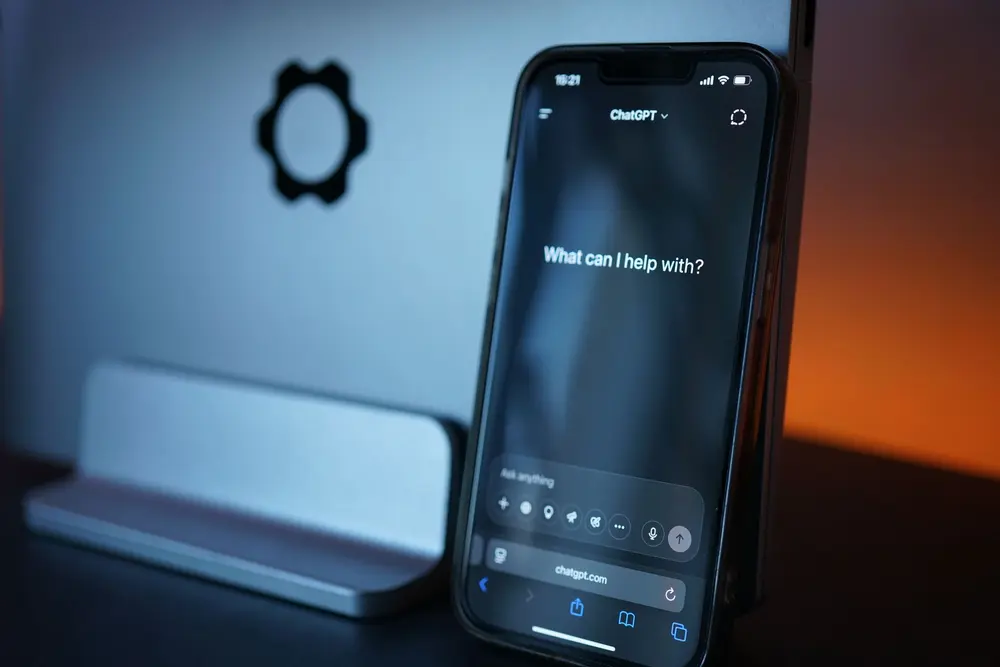
Google is restricting free access to Gemini while OpenAI tests new advertising in ChatGPT and invisibly marks text in the European Union. The changes mainly affect people who use Artificial Intelligence (AI) without an expensive subscription for writing, images, learning, or office tasks. Together, they show the growing price of free AI: less capable models, more commercial space, and additional tracking mechanisms.
What free Gemini users are losing
Starting October 9, people on Gemini’s free plan will reportedly be limited to Gemini Flash Lite. They can currently choose the standard Flash model and Gemini Pro as well. According to The Verge’s lead report, standard Flash will require at least a Google AI Plus subscription, listed at $4.99 per month.
That lower-cost subscription is also being reduced: Gemini Pro is set to disappear from AI Plus. Access to the top model and the advanced “Deep Think” reasoning option will then be reserved for Google AI Pro and Ultra, which the report prices at $19.99 and $99.99 per month, respectively. Google says it will email affected AI Plus customers to tell them when Pro access ends.
Users will still be able to choose low, medium, or high effort levels for each available model. Higher effort can use up the Gemini allowance more quickly, however. If you previously used Gemini Pro for free to summarize lengthy material, compare complicated options, or revise a business report, you will have to move to Flash Lite or pay for a higher subscription.
The source does not establish how large the quality difference will be in routine use. Flash Lite remains available for straightforward work, such as drafting a short email or organizing a list of notes. For more demanding tasks, the relevant change is not merely a smaller usage allowance: two models are being removed from the free plan entirely.
Where ads appear in ChatGPT
OpenAI is expanding its advertising products with visual ads shown alongside image-generation results. In practical terms, an advertising image may appear while you wait for ChatGPT to finish a requested picture. According to TechCrunch’s report on the rollout, the format will initially launch in the United States with a limited test group of advertisers.
OpenAI says the ads will be clearly labeled and will not influence ChatGPT’s answers. That separation has not been independently verified in the supplied sources. The company is also expanding measurement tools and partnerships designed to track clicks, assess campaign results, and determine whether a particular environment is suitable for a brand.
Reports describe the geographic scope from different angles. t3n says OpenAI began showing ads to some ChatGPT users in early February 2026 and expanded its general advertising program to Europe in late August. Its coverage of the new image ads presents them as an extension of that program, while TechCrunch explicitly limits the visual format’s initial launch to the US. The available information therefore does not show that these image ads are already running in Europe.
The placement matters in everyday use because the ad is tied to the moment when you are waiting for a specific creative result, rather than sitting at the edge of a general feed. If you generate a product image for a presentation or an illustration for a community flyer, for example, a commercial message could appear beside it. Whether similar ads will later spread to other parts of ChatGPT remains unclear.
How invisible text watermarks work
In the European Union, OpenAI is introducing an invisible text watermark for eligible ChatGPT and Codex users on all plans. Codex is an AI tool intended for programming tasks. The rollout is expected to take place over several weeks and is OpenAI’s response to transparency requirements under the European Union Artificial Intelligence Act, commonly called the EU AI Act.
The method is called textGrain. It does not add a visible symbol or a notice below the response. Instead, it subtly shapes the model’s word choices to create a statistical pattern that remains when text is copied and pasted. A specialized detector with a secret key can look for that pattern, and OpenAI says the watermark does not identify the person who generated the text.
In its official explanation of the EU approach, OpenAI outlines where the watermark applies, how detection works, and why access to the detector begins with researchers. TechCrunch adds that customers using OpenAI’s application programming interface, a connection that lets other software use a service, can enable watermarking for selected models worldwide. It is off by default there, while the automatic ChatGPT rollout is initially limited to the EU.
The watermark is not definitive proof of origin. In an internal test described in TechCrunch’s watermarking report, detection fell from roughly 92 percent to 66 percent after 10 percent of the words were replaced with synonyms. OpenAI also says short passages, mathematical answers, and translated text are harder to detect.
Ars Technica therefore describes textGrain as potentially useful but relatively easy to disrupt. Existing approaches such as SynthID and the Coalition for Content Provenance and Authenticity (C2PA) standard, which records information about the origins of digital content, can reportedly be circumvented by someone with basic knowledge. The analysis of the detection limits also notes that even OpenAI’s strongest internal results fall short of complete reliability.
The Verge highlights another limitation: detecting a watermark says nothing about whether a text is accurate, who owns it, or how much a person contributed. Conversely, the absence of a detectable signal does not establish human authorship. That distinction matters when a teacher reviews an assignment or a company assesses the origin of a submitted report.
The Decoder reports that textGrain matched or exceeded other tested approaches, including Google’s SynthID, in OpenAI’s internal evaluations, and that OpenAI plans to release the technology as open source. The same report shows how much results can differ by length and subject: at a specified false-positive rate of 1 percent, the detector reportedly found the watermark in about 95 percent of longer passages on psychology but only around 80 percent of shorter passages. These figures come from OpenAI and have not been independently verified in the supplied material.
Pros and Cons of the new limits
Pros:
- More origin information – Machine-readable signals can give platforms and approved reviewers an additional indication that text was generated by AI.
- Some free access remains – Gemini Flash Lite and ad-supported ChatGPT services still provide options that do not require an expensive subscription.
- Unobtrusive labeling – OpenAI says its watermark does not meaningfully reduce general text quality or interrupt reading with a visible label.
- Limited advertising launch – The new visual ads are initially launching in the US and are supposed to carry clear advertising labels.
Cons:
- Less model choice – Free Gemini users are losing Flash and Pro, while the AI Plus subscription is also set to lose Pro access.
- Fragile detection – Limited editing, translation, or a short response can substantially weaken the watermark.
- Commercial pressure – Ads during image generation may make the experience more distracting and could make paid plans appear more attractive.
- Risk of false conclusions – A watermark does not prove accuracy, ownership, or the absence of meaningful human work.
What this means for you
For beginners: Start by deciding what task you actually need to complete before paying for a subscription. Gemini Flash Lite may be sufficient for short drafts, simple summaries, or organizing notes. When using ChatGPT for image generation, check which elements are labeled as advertising and keep promotional claims separate from the generated answer.
For advanced users: Compare demanding tasks with the same source text across the models available to you instead of assuming quality from a model’s name alone. For workplace or school writing, also document which sections are yours and how you edited AI output. A watermark detector cannot replace that record of your process.
The situation remains uneven for Switzerland. The sources do not identify a separate Swiss policy for the Gemini changes, and the initial launch of ChatGPT’s visual ads is described as US-only. Because automatic textGrain watermarking is explicitly limited to the EU, the available information does not establish that it will be enabled by default for ChatGPT accounts in Switzerland.
These developments extend beyond isolated product features: free AI is becoming more tiered, advertising is moving closer to the task itself, and origin signals are becoming part of generated text. Watermarking may improve transparency, but it is technically fragile and cannot serve as standalone proof. The unresolved issues are how widely ads and watermarks will expand geographically and how well detection will work outside internal testing.
Sources
- Google is about to remove free access to Gemini Flash and Pro – The Verge, 2026-10-06
- OpenAI will watermark ChatGPT outputs by default—but only in the EU – Ars Technica, 2026-10-06
- Mehr Werbung in ChatGPT: OpenAI platziert visuelle Anzeigen in seine Bild-KI – t3n, 2026-10-06
- OpenAI will start watermarking ChatGPT’s text in the EU – TechCrunch, 2026-10-05
- OpenAI is adding text watermarking in ChatGPT and Codex – The Verge, 2026-10-05
- OpenAI versieht ChatGPT-Texte mit unsichtbarem Wasserzeichen – The Decoder, 2026-10-05
- OpenAI launches visual ads that appear alongside image generation results – TechCrunch, 2026-10-05
- Our approach to EU text provenance rules – OpenAI, 2026-10-05
Image: Tim Witzdam via Pexels